Building a helmet range for your bicycle shop
PublishedBy Diego – Pro Sport Lights
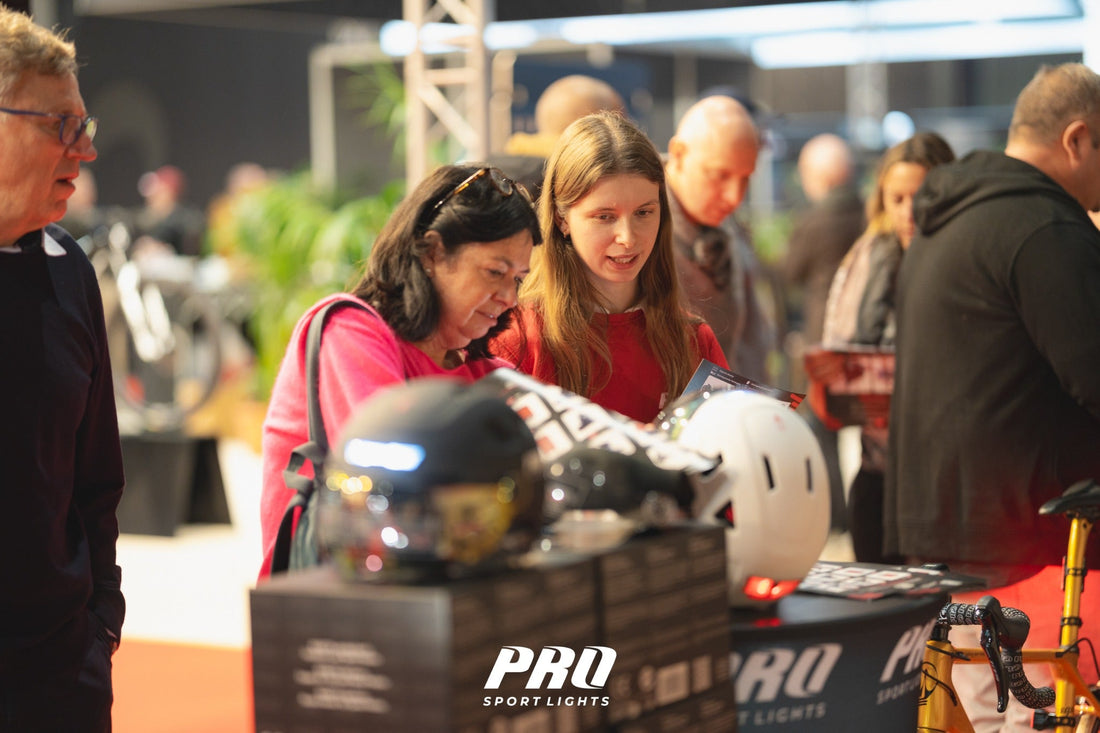
Building a first helmet range for your bicycle shop starts with the customers you help every day. What bicycles do they ride? Which questions keep coming up at the counter? And which sizes can you actually offer for fitting? Those answers help you choose a range that your staff can explain clearly and that you can replenish with purpose.
This guide helps you prepare an initial selection of Pro Sport Lights bicycle helmets. You can also use the steps to review an existing range before adding a new product line as a specialist bicycle shop or distributor.
1. Map out the questions asked in your shop
During a few sales conversations, note what customers are looking for and where your current range does not yet meet their needs. Distinguish between how they use their bicycle, the features they want and the fit. This prevents an eye-catching colour or a single product feature from determining the whole selection.
- Use: do customers mainly need a helmet for daily city rides, e-bike commuting or a speed pedelec?
- Preferences: do they ask for a visor, extra visibility, protection around the ears or turn-signal controls?
- Fitting questions: which head circumferences and combinations with glasses do you see regularly? Where is it currently difficult to achieve a good fit?
Turn those observations into a short brief for your range. For example: “We want customers to be able to try on a helmet with a visor, and we want to demonstrate the difference between summer and winter equipment.” This gives direction to the models and accessories you consider.
2. Give each model a clear role
A useful selection has differences you can explain at the counter. Within the current PSL range, you can consider these models in response to the following customer questions:
- ClearView: for discussing a helmet with two visors. This NTA 8776 model comes with a clear and a dark visor. A Winter Kit with lining and ear warmers is optional. Make it clear in your presentation what is included as standard and what is selected separately.
- ICE: for customers who want to look at a helmet with visors and ear warmers. This model also has NTA 8776 certification. A clear and a dark visor, removable ear warmers and tools for changing the visor are part of the described equipment.
- Signal: for demonstrating lighting and wireless turn signals. The handlebar remote is included. Assess this model on those features and its fit; do not extend the NTA 8776 certification of ClearView and ICE to Signal.
Check the current product information for each model when making your selection. Helmet lighting provides additional visibility and does not replace bicycle lights.
3. Plan size coverage before adding colours
A size letter does not represent the same head circumference throughout the range. ClearView is available in M (50–57 cm) and L (54–61 cm), ICE in M (49–55 cm) and L (53–60 cm), and Signal in M (50–56 cm) and L (54–61 cm). Always check the range for the specific model.
Decide which sizes you want customers to try on and which variants you want to stock for sale. Have staff assess head circumference, adjustment and stability together. Customers who wear glasses should also try the helmet with their own glasses. Sizing is the starting point; a fitting is still necessary.
Only then consider which colours complement your selection. Two colours in one size do not help a customer who needs a different size. Match quantities to your own customer needs, available space and budget.
4. Keep demonstration units and sales stock clearly separate
Record the following for each item in your own overview: model, size, colour, item number, role in the shop and desired quantity. Indicate which unit is intended for demonstrations and which units are available for sale. Discuss with us how to put that presentation into practice.
A simple demonstration routine helps the team: first fit and adjust the helmet, then examine the visor, and finally show the relevant lighting or controls. Note any questions a member of staff cannot yet answer. Those questions are a useful starting point for your next contact with the supplier.
Review the selection using your own data. Record not only what sold, but also which size, colour or feature a customer wanted and could not find. This lets you make an informed reorder instead of expanding the whole range at once.
5. Include suitable accessories in your selection
Choose accessories for the models you actually want to carry. Keep spare visors and winter accessories clearly grouped by model and check the correct size too. ClearView and ICE visors, for example, are not interchangeable.
Make a short internal list with three parts: what comes with the helmet, what is optional and which replacement part belongs to it. This allows every member of staff to give the same explanation. See the current options in our B2B catalogue for bicycle shops.
6. Prepare the conversation about working together
Bring your provisional selection to an introductory meeting. Discuss purchasing terms, ordering options, delivery, replenishing the range and how parts or service queries are handled. We agree specific terms personally.
This information will help us address your questions more effectively:
- Your shop name, location and main customer groups.
- The helmets you already carry and the questions you still want to be able to answer.
- The models, sizes and accessories you want to see.
- The display space available and your questions about ordering and service.
Discuss your helmet range at Velofollies 2027
Pro Sport Lights will be at stand 446 at Kortrijk Xpo from 22 to 24 January 2027. Come and meet us as a bicycle shop, specialist retailer or prospective distributor, and discuss which selection suits your shop. You can also read our main invitation to Velofollies 2027. Practical visitor information is available on the official Velofollies website.
See you at stand 446!
Diego – Pro Sport Lights
Image: Pro Sport Lights, own photo archive.