
Choosing and Using a Bicycle Torque Wrench: Range, Bits and Torque
PublishedBy Pro Sport Lights · Content updated
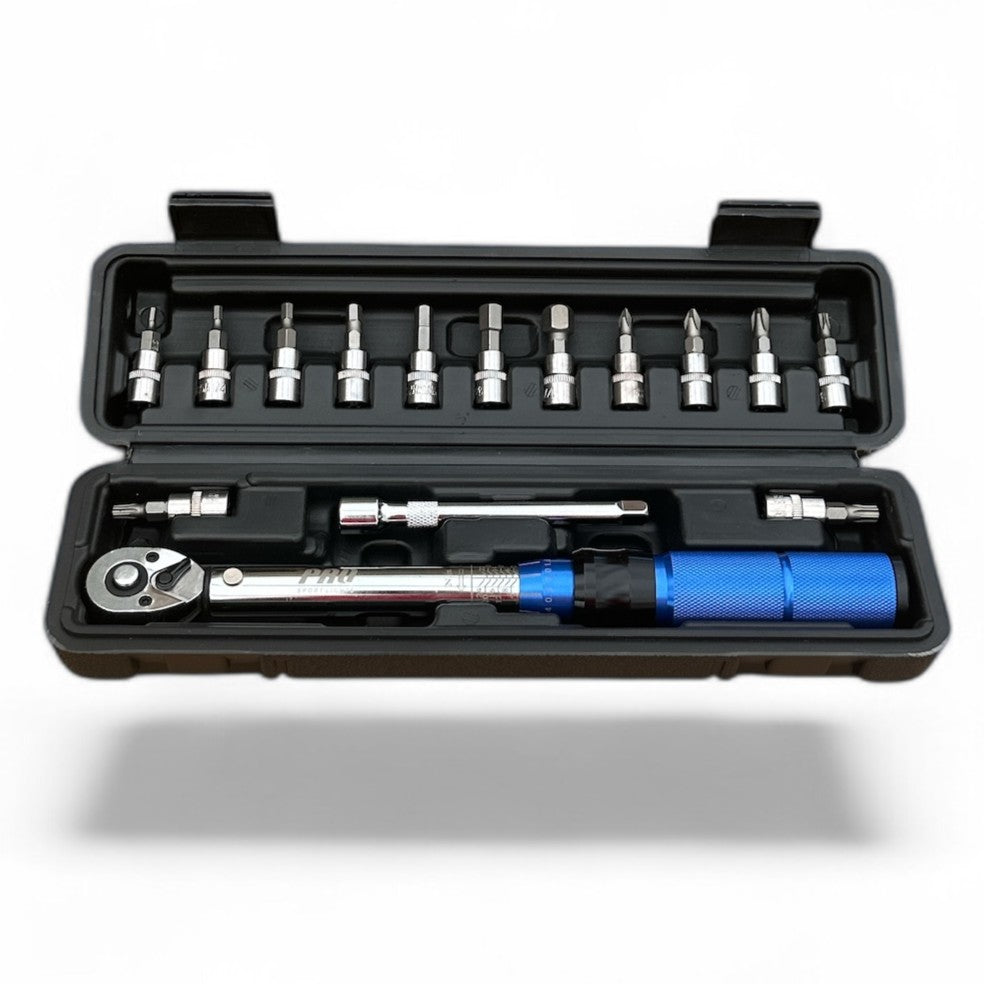
The short answer: Choose a torque wrench whose range includes your component's specified assembly torque. Then check the drive and required bit or socket size. A digital readout, more bits or a higher maximum value is not automatically better for your task.
For your road bike, mountain bike or e-bike, start with the fastener you are working on. This guide compares Pro Sport Lights bicycle sets, explains the difference between scale increments and accuracy, and helps you use the tool according to the instructions.
How to determine the correct tightening torque
Find the value on the component or in the bicycle and component manufacturer's documentation. Also check the required preparation of threads and contact surfaces. Use lubricant or assembly paste only where the manufacturer specifies it.
There is no fixed Nm value for every stem, seatpost or carbon component. A general table is a reference at most. Park Tool explains the relationship between tightening torque and bolted connections and refers you to the manufacturer for current specifications.
Which torque wrench set suits your assembly work?
Start with the range, then compare the contents. All bicycle models compared below have a 1/4-inch drive. Bits, sockets and adapters differ between sets.
| Model | Range | Choose by these features |
|---|---|---|
| Compact, 16 bits | 1–10 Nm | Low starting range, 16 bits and 0.2 Nm setting increments. |
| Hex/Torx basic set | 2–24 Nm | Hex 3–10 mm and Torx T20/T25/T30; extended 5 mm hex bit. |
| Stainless steel set | 2–24 Nm | Stainless steel, 13 bits: hex 2.5–10 mm, Torx T20/T25/T30 and PH1–PH3. |
| Royal set | 2–24 Nm | Includes 2 mm hex and Torx T27; chrome vanadium. |
| Red/black set | 2–24 Nm | 72-tooth ratchet; bits, sockets and adapters in a case. |
| 14-bit set | 2–24 Nm | Torx up to T40, Phillips and slotted 4/7 mm; click signal. |
| 32-piece set | 2–24 Nm | More bit and socket sizes; stated accuracy ±3%. |
| 13-bit set | 2–24 Nm | Stainless steel, seven hex, three Torx and three Phillips bits. |
| Digital 1–20 Nm | 1–20 Nm | Digital display starting at 1 Nm; no listed bit set. |
| Digital, 26-piece | 1.5–30 Nm | Digital display; bits, sockets and adapters; AAA batteries. |
A specified value below 2 Nm falls outside a 2–24 Nm model's range. Compact starts at 1 Nm, as does the digital 1–20 Nm model. For a value above 24 Nm, the digital 1.5–30 Nm model offers a higher range. A value outside these ranges requires another suitable tool.
According to the current product specifications, the stainless steel set and 13-bit set have the same range and bit sizes. Compare their versions and current product pages; there is no stated measurement accuracy difference between these two models.
View all torque wrenches, current contents and availability.
Car maintenance requires a separate choice
The 1/2-inch car torque wrench 20–200 Nm has impact sockets of 17, 19 and 21 mm. It is not a substitute for low torque on small bicycle fasteners. For wheel bolts, use the vehicle or wheel manufacturer's value and sequence.
Mechanical or digital: what changes?
For the 14-bit bicycle set and car set, the product description states an audible and tactile click. The two digital models have a backlit LCD, setting lock and an LED and beep signal at the set torque. Refer to your model's manual for operation and the torque signal.
Choose digital operation if you prefer that display and setting method. Choose a mechanical set when its operation and contents suit your work. A digital display alone does not prove a smaller measurement tolerance.
Scale increments are not measurement accuracy
0.2 Nm is a setting increment. The stated accuracy of ±3% appears in the current specifications of the 32-piece bicycle set and car set. It does not establish an accuracy claim for other models. An unspecified certificate also does not prove a particular ISO standard or individual calibration result.
Using your torque wrench
- Check the range, measurement direction and matching bit or socket in the manual.
- Set the specified value and insert the bit fully and straight into the bolt head.
- Hold the wrench at the indicated position on the handle and apply force steadily.
- Stop as soon as your model indicates the set torque.
- For multiple bolts, follow the specified assembly sequence.
On a click-type wrench, the sound may be less obvious at low settings. Pay attention to your model's specified torque signal and do not continue tightening. Further information: Park Tool on torque wrench use and care.
Common mistakes
- Applying an example value to every bicycle component.
- Using a value outside the adjustable range.
- Confusing scale increments with measurement accuracy.
- Continuing to tighten after the torque signal.
- Using the torque wrench to break loose seized bolts.
- Using the wrong bit size or working at an angle.
Storage and maintenance
Store the tool clean, dry and protected. Follow your model's storage and calibration instructions. For click types, Park Tool describes storage at the lowest scale value, not below the range. Check the tool after a hard drop.
Frequently asked questions
Is 2–24 Nm enough for my whole bicycle?
Only for fasteners whose specified value falls within that range and for which you have the correct bit or socket. Check every component separately.
Which set should I choose if I need Torx T27 or T40?
Royal includes T27. The 14-bit and 32-piece sets include T40. Always check the complete product contents for the other sizes you need.
Can I measure torque anticlockwise with a reversible ratchet?
A selectable ratchet direction does not automatically confirm measurement in both directions. Your model's manual determines the permitted measurement direction.
Need help choosing? Email info@prosportlights.com with the component, specified tightening torque and required bit or socket size. This lets us help you choose a suitable set for your task.